Driver's License Practice Test
- 4.7
- Rating
- 100.00K
- Installs
- Free
- Price
 Analysis by App-foxy
Preparing for a driving test can feel strangely difficult because the challenge is not only remembering rules. You also need to recognize the wording used in questions, separate similar signs, and stay calm when two answers look almost correct. I spent time with Driver's License Practice Test to see whether it works as a practical study companion rather than simply another quiz app. My overall impression is positive: it is focused, easy to pick up, and especially useful when you want short practice sessions instead of a long lesson.
This is a free education app from Rall Softwares, aimed at people preparing for a driver's license test. It has an Everyone age rating, a 4.7 average from around 7,500 ratings, and more than 100,000 installs. Those figures suggest that it has found a clear audience, but they do not remove the need to decide whether its particular study style suits you. A practice app can be helpful without replacing the official handbook, instructor advice, or the real responsibility of learning to drive safely.
How I Judged Its Value as a Study Tool
When I evaluate an app like this, I look beyond whether it displays questions. The important points are how quickly I can begin, whether practice fits into an ordinary day, whether mistakes become useful lessons, and whether the app encourages understanding instead of guessing. I also consider what happens when the app is not enough: a learner may need local rules, detailed explanations, or direct guidance from a qualified instructor.
You May Also Like

 Blood Strike: 2.5 Anniversary
Blood Strike’s Loadouts Turn Every Drop Into a Tactical Gamble
A close look at Blood Strike’s custom loadouts: how fast access to signature weapons reshapes its battle royale rhythm, rewards preparation, and narrows the gap between fights.

 Pandora - Music & Podcasts
Pandora’s Music Is Easy to Start, but Harder to Recover
Pandora’s strength is its low-effort path from a seed to a station. Its weak spot is how much confidence it asks you to place in connection, setup, and quiet recovery.

 8 Ball Pool
 Is Built on Rivalries, Rematches, and Routine
A close look at the rivalries, rematches, shared routines, and unanswered safety questions that turn a quick pool match into a persistent mobile community.

 Samsung Music
’s Quiet Strength Is Playing What You Already Own
Its reach comes less from spectacle than from dependable access to a personal library. That simplicity is both the app’s strongest retention engine and its ceiling.

 AccuWeather: Weather Radar
AccuWeather Review: A Quick, Clear Forecast for Everyday Decisions
For everyday plans, the best forecast is the one you can understand quickly. AccuWeather makes rain timing, radar, and local conditions easy to act on, with a few trade-offs.

 Hill Climb Racing
Why Hill Climb Racing Still Turns Crashes Into One More Run
A tiny car, a bumpy hill and one more upgrade: Hill Climb Racing keeps resurfacing because its simple chaos makes every near-miss feel personal.
More From Our News Desk



That last point matters because driving tests are not identical everywhere. Road signs, legal limits, right-of-way rules, and test wording can depend on the jurisdiction. I therefore treat this app as a revision aid, not as the only authority. Before relying on any answer for an actual test, I would compare it with the official material used by the local licensing authority.
The first practical advantage is immediacy. I can open the app when I have a few spare minutes and start reviewing without arranging a full study session. That makes it a good match for the small gaps that are easy to waste: waiting for an appointment, sitting on public transport, or taking a short break after work. The format encourages repeated contact with the subject, which is often more realistic than promising myself an hour of study and never finding the hour.
I also paid attention to how the app fits different levels of preparation. A complete beginner may use it to discover which subjects feel unfamiliar, while someone closer to the exam can use it to check recall under pressure. The same question-based approach can serve both users, but the benefit changes. Early on, it helps reveal gaps. Later, it is more useful as a quick confidence check and a way to identify topics that still need reading.
Why short practice sessions work well here
My most useful routine was to avoid treating every session as a test of pride. Instead, I used a short cycle: answer a group of questions, note the ones I hesitated over, and then return to the relevant rule in the handbook. This is more effective than immediately repeating the same questions until the answers become familiar. Recognition can create false confidence, while explaining the rule in my own words shows whether I actually understand it.
A second helpful habit is to separate careless errors from knowledge gaps. If I knew the rule but rushed, the remedy was slower reading. If I had confused two signs or misunderstood priority, I needed study away from the app. That distinction prevents the common mistake of assuming that a higher practice score automatically means better road knowledge.
The app is also convenient for learners who dislike bulky revision materials. A phone-based quiz is easier to carry and less intimidating than opening a thick manual every time. I found that convenience valuable, but it has a trade-off: a compact quiz environment can make complicated topics feel simpler than they are in real traffic. The app works best as one layer in a broader routine.
Where this app stands out
Its strongest quality is focus. Driver's License Practice Test does not try to become a navigation tool, a driving simulator, or a general transport app. Its purpose is revision for the written side of licensing, and that narrow purpose makes it easy to understand. Someone searching for a direct way to practice questions will not have to learn a large system before studying.
That focus is particularly useful for people who already know how they want to study. I can use the app for retrieval practice, then switch to official reading when a question exposes a weakness. In that workflow, the app acts like a checkpoint rather than pretending to be the entire course. I would recommend this approach to a friend because it gives the quiz a clear job and avoids overestimating what a phone screen can teach.
Another strength is its suitability for repeated, low-pressure use. A learner who feels overwhelmed by the idea of “studying for the driving test” may find it easier to answer a few questions than to begin with a large textbook. That small entry point matters. Regular contact with signs and rules can make later study less intimidating, especially when the user reviews mistakes instead of hiding them.
The app’s free entry point also lowers the barrier to trying it. There are in-app purchases ranging from $1.90 to $19.99 per item, so I would check what is included before paying for anything. The important decision is not simply whether a purchase exists, but whether extra material solves a real problem for you. If the free experience already supports your revision routine, spending more may not improve your understanding. If you need a broader question supply or additional study support offered inside the app, the value depends on how closely it matches your local test.
Three study techniques that make it more useful
First, I would use a “three-column” note on paper or in a separate notes app: the question topic, the answer I chose, and the reason I chose it. The third column is the important one. Writing “because this sign means…” exposes guesses that might otherwise look like knowledge. After several sessions, the notes show patterns, such as repeated confusion around priority or sign shapes, rather than a random collection of wrong answers.
Second, I would practice at two different speeds. In one session, I would read carefully and focus on the rule. In another, I would answer under gentle time pressure. This reveals whether the problem is memory or rushed interpretation. A learner who performs well only when moving slowly may need to improve question reading, while someone who answers quickly but cannot explain the rule needs deeper study.
Third, I would pair every difficult question with a real-world observation. If the topic involves signs, I would notice those signs during a walk or passenger trip. If it involves road positioning or priority, I would discuss the situation with an instructor rather than trying to infer everything from a quiz. This turns abstract revision into visual memory, while keeping the app in its proper role.
Where another option may fit better
The usual alternatives fall into several groups. An official handbook or licensing-authority website is better when accuracy for a particular region is the priority. It is usually the place I would check for the wording of current rules, required documents, and local test expectations. The disadvantage is that official material can feel slower to revise, especially when I want quick feedback on whether I remember a topic.
A driving instructor is better when I do not understand why an answer is correct or how a rule applies in traffic. An instructor can adapt an explanation to my mistake and connect theory with observation behind the wheel. No quiz app can fully replace that personal correction. For a nervous beginner, direct coaching may provide more value than completing many practice questions alone.
Printed books and larger digital courses can also be preferable for learners who want structured teaching from the basics. They may make it easier to follow a planned sequence and read explanations in depth. On the other hand, they are less convenient for a quick session. I see Driver's License Practice Test as the lighter, faster option: useful for recall and repetition, less suitable as a complete curriculum.
Video lessons may help visual learners who need to see road situations explained. They can show movement and context that a question cannot. The trade-off is that watching feels passive unless I pause and test myself. The app is more demanding in a useful way because it asks me to commit to an answer, but it may feel less clear when a subject needs a diagram or a detailed walkthrough.
I would also be cautious if a learner is studying for a highly specific local exam and expects every question to mirror the official test. The app’s general purpose is clear, but I would still verify local details independently. In that situation, an official regional resource should lead the study plan, with this app used for extra recall practice rather than treated as the final word.
The real cost of changing study methods
Switching from this app to a handbook, course, or instructor is not only about money. It also changes the effort required. A handbook demands more reading and self-direction. An instructor requires scheduling and attention at a fixed time. A video course may be easier to follow but can encourage passive watching. Moving away from a quick quiz can therefore reduce convenience even if it improves depth.
The reverse switch has its own cost. Someone who abandons a detailed course for short quizzes may gain flexibility but lose explanations and structure. I would not replace a method that is teaching me effectively just because this app is easier to open. Instead, I would use it to fill the gaps between more complete study sessions. That combination gives quick recall practice without discarding reliable instruction.
There is also a mental cost to chasing scores. If I keep repeating familiar questions, I may feel productive while avoiding the topics I find difficult. My advice is to use the app as a diagnostic tool: let mistakes decide what to study next. A lower score can be useful when it points directly to a weakness, while a high score based on memorized patterns may not say much about readiness.
Because the app is free to start, trying it carries little financial risk. Still, I would not purchase an item simply because I was frustrated by a poor session. First I would identify whether the problem is missing content, unclear understanding, or weak concentration. A purchase can only help if it addresses the actual problem. This is a small but important protection against spending money on more questions when what I really need is an explanation or an instructor.
Who should use it, and who should skip it?
I think it is a strong fit for a learner who wants a straightforward revision tool, prefers studying in short bursts, and is willing to verify important rules with official local material. It is also useful for someone who has already read the basics and wants to keep knowledge active during the days before an exam. The app’s simple purpose makes it easy to add to an existing routine without rebuilding the whole routine around it.
I would be more cautious recommending it to a person starting from zero who expects complete teaching. If you do not know the basic signs, cannot explain right-of-way, or need help applying rules to real traffic, begin with an official guide and an instructor. Use the app after that foundation is in place. I would also suggest another primary resource for anyone whose test preparation depends on region-specific wording or detailed explanations.
The Everyone rating makes it accessible to a broad audience, including younger learners who are beginning to explore road safety. Accessibility, however, should not be confused with readiness to drive. A young user still needs appropriate supervision, formal instruction, and the legal permissions required in their area. The app can support learning, but it cannot authorize practice on public roads or replace responsible adult guidance.
Practical details before you commit
Rall Softwares released the app on May 25, 2022, and the current version is 1.6.1. It supports devices running Android 7.0 or later. For most people, the main question is not technical compatibility but whether the app fits their study material and habits. I would install it, try a few sessions, and compare the questions with the rules I am expected to know before building a serious revision plan around it.
The free price is a clear advantage for testing that fit. At the same time, the presence of optional purchases means I would read each purchase screen carefully and decide what I am actually receiving before confirming anything. I would not assume that paying automatically makes the app more accurate or more appropriate for a particular jurisdiction. Content relevance matters more than the price tag.
One everyday scenario shows where it earns its place. Imagine finishing a driving lesson with two confusing topics still in your mind. On the way home, you use a short app session to see whether the confusion appears in several questions. Later, you open the handbook and ask your instructor about the exact point you missed. The app has not taught the entire lesson, but it has helped turn a vague concern into a specific question. That is a worthwhile use of a practice tool.
My recommendation
After using it as a revision companion, I would recommend Driver's License Practice Test to people who want convenient question practice and understand its limits. Its best role is between deeper study sessions: checking recall, exposing weak areas, and keeping road rules active in memory. The strong user rating and growing install base make it an appealing app to try, but my recommendation rests more on its focused workflow than on popularity.
I would not use it as my only preparation. I would keep the official handbook nearby, confirm local rules, and use an instructor whenever an answer does not make sense in a real driving situation. If you want a complete course with extensive explanations, another option may fit better. If you want a free, accessible way to turn spare minutes into deliberate practice, this app is a sensible choice.
My final advice is simple: do not measure readiness by how many questions you can recognize. Measure it by whether you can explain the rule, spot it on the road, and apply it safely without guessing. Used that way, this app becomes more than a collection of quizzes. It becomes a practical checkpoint in a broader learning plan, and that is where I think it delivers its best value.
FAQs for Driver's License Practice Test
01What types of questions can I expect in the Driver's License Practice Test app?
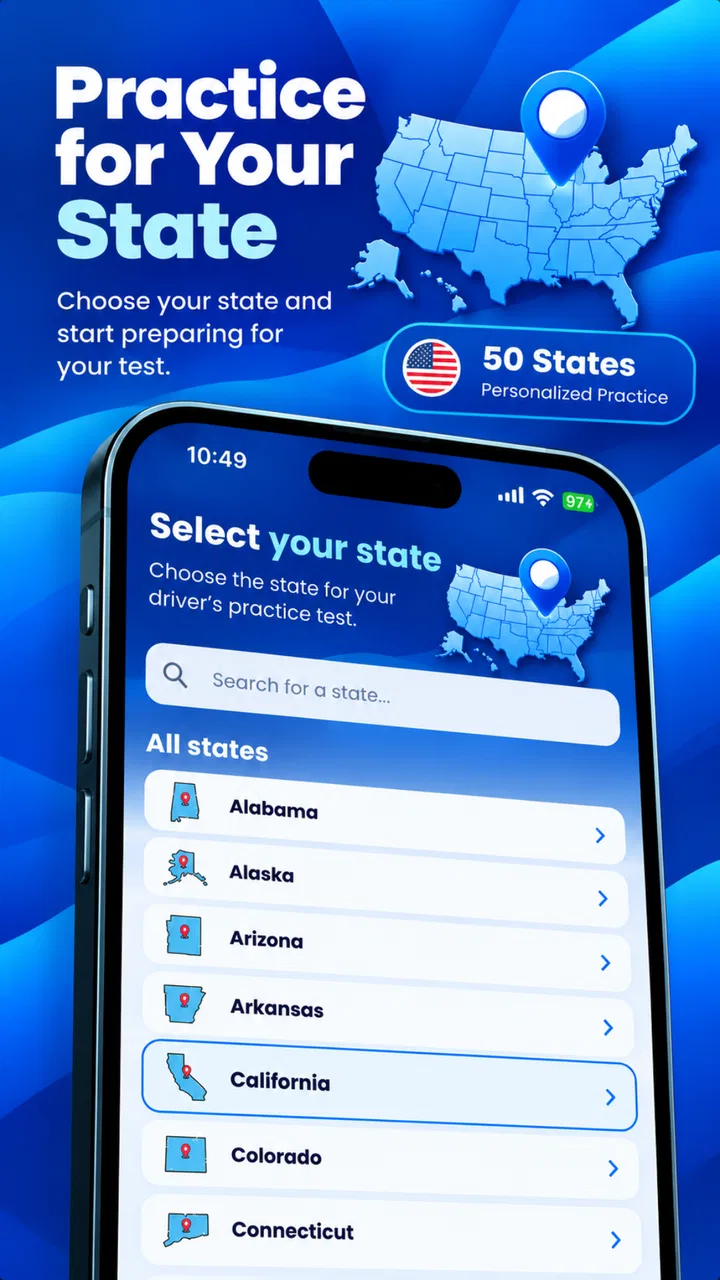
The Driver's License Practice Test app offers a variety of questions that cover all essential aspects of driving regulations, road signs, and safety rules. This includes multiple-choice questions based on your state's specific driving handbook, ensuring you're well-prepared for the actual test.
02Is the Driver's License Practice Test app available for both Android and iOS devices?
Yes, the app is available for both Android and iOS platforms. You can download it from the Google Play Store for Android devices and the Apple App Store for iOS devices. Ensure your device meets the app's compatibility requirements for a smooth experience.
03Does the app require an internet connection to function?
While an internet connection is needed to download and initially set up the app, many features, such as practice tests and study guides, are accessible offline. This allows you to study and practice without needing a constant internet connection, making it convenient for on-the-go use.
04Are there any in-app purchases or ads in the Driver's License Practice Test app?
The app is free to download and offers basic practice tests. However, it may include optional in-app purchases for premium features, such as advanced practice modes or ad removal. Some ads might be present in the free version, but they are typically non-intrusive.
05How accurate and up-to-date are the questions in the app?
The app regularly updates its question database to ensure alignment with the latest state-specific DMV handbooks and regulations. This ensures that users are practicing with current information, enhancing their chances of passing the actual driver's license exam.
Pros
- Comprehensive question database.
- User-friendly interface design.
- Offline mode available.
- Progress tracking features.
- Customizable practice tests.
Cons
- Limited free content.
- Ads can be intrusive.
- No voice-over support.
- Occasional app crashes.
- In-app purchases required.

Driver's License Practice Test
Gallery